
Sounds like Grolsch
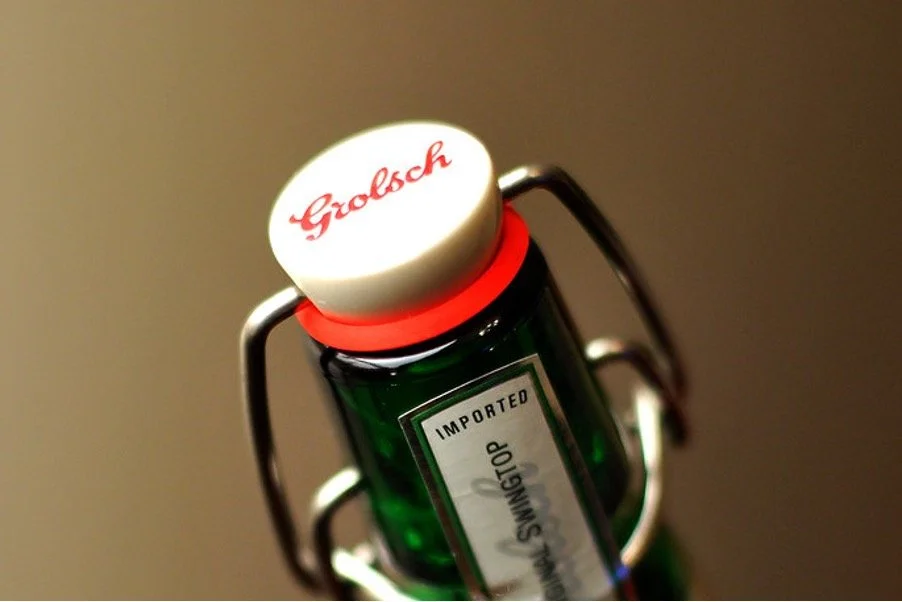
When you think of Grolsch, you think of its characteristic swing-top bottle. And of the distinctive pop when it is opened. That sound has played a prominent role in Grolsch advertising for many years and also features in its recent 2026 campaign, “Cheers to character, sounds like Grolsch”. The popping sound has therefore become closely associated with the brand.
Grolsch has effectively been using the pop as a kind of sound mark for decades. Perhaps it was time to actually register it as a trademark, Grolsch recently thought. But despite its long-standing use and recognition in the Netherlands, registering the popping sound is by no means straightforward. Sound marks, too, must meet the requirement of distinctive character. Consumers must be able to identify the commercial origin of the product from the sound. A very commonplace melody will not suffice, as it lacks distinctiveness. In Grolsch’s case, the pop is not a jingle but rather a sound produced when the bottle is opened. Grolsch evidently anticipated some difficulty and filed the sound in the Benelux as a multimedia mark, with the Grolsch logo providing a visual point of reference. That mark was accepted by the Benelux Office without difficulty.
Grolsch took a more ambitious approach before the European Union Intellectual Property office (EIUPO): there, the pop was filed as a sound mark, without the Grolsch logo or any other visual elements. Unfortunately for Grolsch, the EUIPO considered the mark to lack distinctive character. The precise reasoning cannot be established, as Grolsch withdrew their application. Most likely, however, the EUIPO took the view that, for the average consumer, the sound is generic and is not in itself capable of distinguishing the goods of one undertaking from those of another.
Grolsch could have attempted to show that the sound had already acquired distinctive character through use by submitting evidence of acquired distinctiveness. That, however, can be a costly exercise and is particularly challenging for an EU trademark, where acquired distinctiveness must be demonstrated across the relevant parts of the European Union. this is especially difficult given that Grolsch is very well known in the Netherlands, but considerably less so in such countries as Belgium and Germany.
No success at EU level, then, but in the Benelux Grolsch at least shas something to rely on. One point is nevertheless striking: priority from the Benelux mark was claimed for the EU application and was accepted. Claiming priority, so that protection dates back to the filing date of the original application, is of course, common. In this case, however, the Benelux registration concerns a very different type of mark from the EU application.
The EUIPO does not examine priority claims substantively, in order to avoid unnecessarily delaying the registration procedure. Yet a trademark register is precisely where third parties should be able to rely on accurate information about a mark. In our view, the absence of such a check is therefore a shortcoming. An interested party would need to know that this aspect has not been verified.
Author: Arnaud Bos
Bio: Arnaud is trademark attorney and within Knijff responsible for the marketing & communication. Arnaud is specialist in the metaverse and music sectors and his client portfolio includes many upcoming and renowned bands. He keeps a close eye on the latest case law in the EU and will let you know when he sees remarkable applications.